Digging Deeper: Bodrum's Ancient Past Goes Way Beyond That Famous Castle
Here's something most American tourists don't realize until they're already on the plane home: Bodrum isn't just a pretty beach town. It's built on top of one of the most consequential cities in the ancient world. Halicarnassus—as it was known to the Greeks—was the capital of a powerful Aegean kingdom, the birthplace of Herodotus (yes, the "Father of History" himself), and home to a tomb so magnificent that it gave us the word "mausoleum." If you're even a little bit of a history nerd, this place will absolutely blow your mind.
The catch? Most of the good stuff is hiding in plain sight, tucked between boutique hotels and fish restaurants, and almost entirely overlooked by travelers who are busy admiring the castle. Consider this your permission slip to slow down and go digging—figuratively, of course.
What's Left of the Mausoleum at Halicarnassus
Let's start with the big one. The Mausoleum at Halicarnassus was one of the Seven Wonders of the Ancient World, built around 350 BCE as a tomb for the Carian king Mausolus and his queen Artemisia. It stood for roughly 1,600 years before earthquakes and medieval stone-robbers reduced it to rubble. Today, the site sits in the middle of a quiet residential neighborhood—not exactly where you'd expect to find a wonder of the ancient world.
What remains is more evocative than it might sound. You can walk the original foundation, peer into underground chambers, and see the massive stone blocks that once formed the base of a structure that reportedly reached 140 feet tall. An on-site museum provides context through scale models, architectural fragments, and a fascinating breakdown of how historians have pieced together what it once looked like. It costs next to nothing to enter—think a couple of dollars—and on most mornings, you'll have the whole place nearly to yourself. Compare that to battling bus tour crowds at the Acropolis in Athens, and you'll start to understand why history-focused travelers are quietly redirecting their itineraries to Bodrum.
The Bodrum Museum of Underwater Archaeology: A Genuine World-Class Institution
Yes, the castle is worth seeing—but the reason to actually go inside is the museum it houses. The Bodrum Museum of Underwater Archaeology, operating out of the medieval Castle of St. Peter, is widely recognized as one of the finest museums of its kind anywhere on the planet. That's not marketing fluff; archaeologists and maritime historians have been saying it for decades.
The collection includes artifacts recovered from Bronze Age and Byzantine shipwrecks found in the surrounding waters, including the oldest known shipwreck ever discovered—the Uluburun wreck, dating back to around 1300 BCE. The cargo alone reads like an ancient trade manifest: gold jewelry, copper ingots, ebony logs, glass, and pottery from Egypt, Canaan, Cyprus, and the Aegean. Seeing all of it laid out in a single museum gives you a visceral sense of just how connected the ancient Mediterranean world really was.
Budget at least two to three hours here. The exhibits are extensive, and the castle's layout—spread across multiple towers and courtyards—means there's always another room you haven't explored yet.
Getting Off the Main Path: Local Excavation Sites
For travelers willing to rent a car or hire a local guide, Bodrum's wider peninsula hides a string of lesser-visited Hellenistic and ancient Carian sites that rarely show up in mainstream travel guides.
The ancient theater on the hillside above the town is a good starting point. Carved into the slope in classic Hellenistic fashion, it once seated around 13,000 spectators and is still impressively intact. Views over the bay from the upper tiers are genuinely spectacular, and it sees a fraction of the foot traffic that comparable sites in Turkey's more tourist-heavy regions attract.
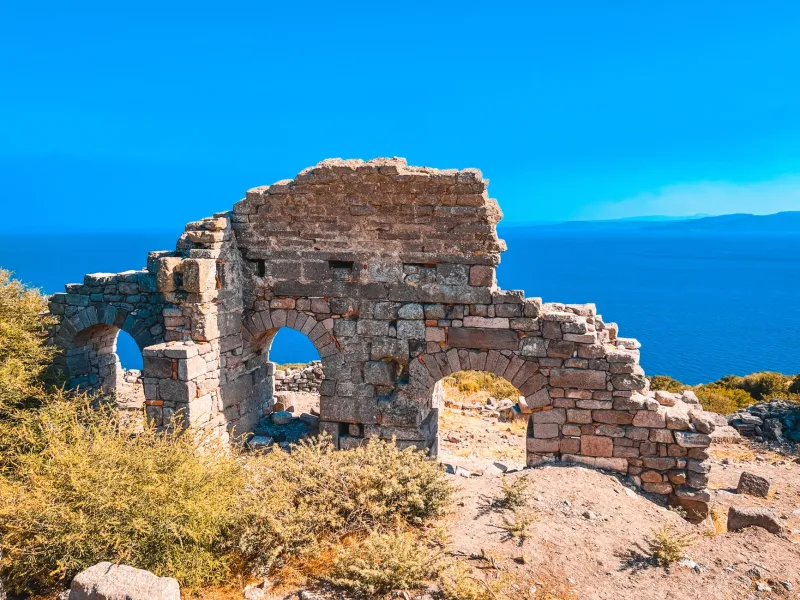
Further afield, the Myndos Gate—the only surviving section of Halicarnassus's ancient city walls—sits at the western edge of modern Bodrum, largely unannounced. Alexander the Great launched his siege of the city from this very spot in 334 BCE. There's no ticket booth, no gift shop, just a stretch of ancient stonework with a small informational sign. It's the kind of place that makes you stop and recalibrate your sense of how old "old" really is.
Local guides familiar with the peninsula can also point you toward partially excavated sites near the villages of Pedasa and Theangela, where ongoing archaeological work continues to turn up new finds. Some of these digs operate seasonal volunteer programs, which is worth looking into if you're planning an extended stay.
How to Plan Your Archaeology Days
Bodrum's history sites are best explored in the cooler morning hours, especially between June and September when midday temperatures climb fast. The Mausoleum site and the underwater archaeology museum are both within easy walking distance of the town center, so you can realistically combine them in a single full day without a car.
For the outer peninsula sites, a half-day guided tour is your most efficient option. Several local operators specialize in archaeology-focused tours and can provide context that transforms a pile of ancient stones into something genuinely moving. Look for guides with formal training in classical history or archaeology—many are connected to the local university or regional museums and bring a level of detail that generic city tours simply can't match.
English-language guided tours run regularly during peak season and are easy to book through most hotels or the local tourism office. Prices are a fraction of what you'd pay for comparable experiences in Greece or Italy.
Why Bodrum Deserves a Spot on the History Traveler's Map
There's a version of Bodrum that exists entirely on Instagram—yachts, rooftop bars, turquoise water. That version is real and completely worth experiencing. But underneath it, literally and figuratively, is a city with a history that stretches back thousands of years and connects to some of the biggest stories in the ancient world.
For American travelers who love history but feel priced out of Western Europe, or exhausted by the crowds at more famous Mediterranean destinations, Bodrum offers something genuinely rare: world-class archaeology, thoughtfully presented, in a setting that hasn't yet been overrun. The sites are accessible, the entrance fees are modest, and the locals who work in and around them tend to be genuinely passionate about sharing what they know.
Don't just see the castle. Go find what's underneath it.